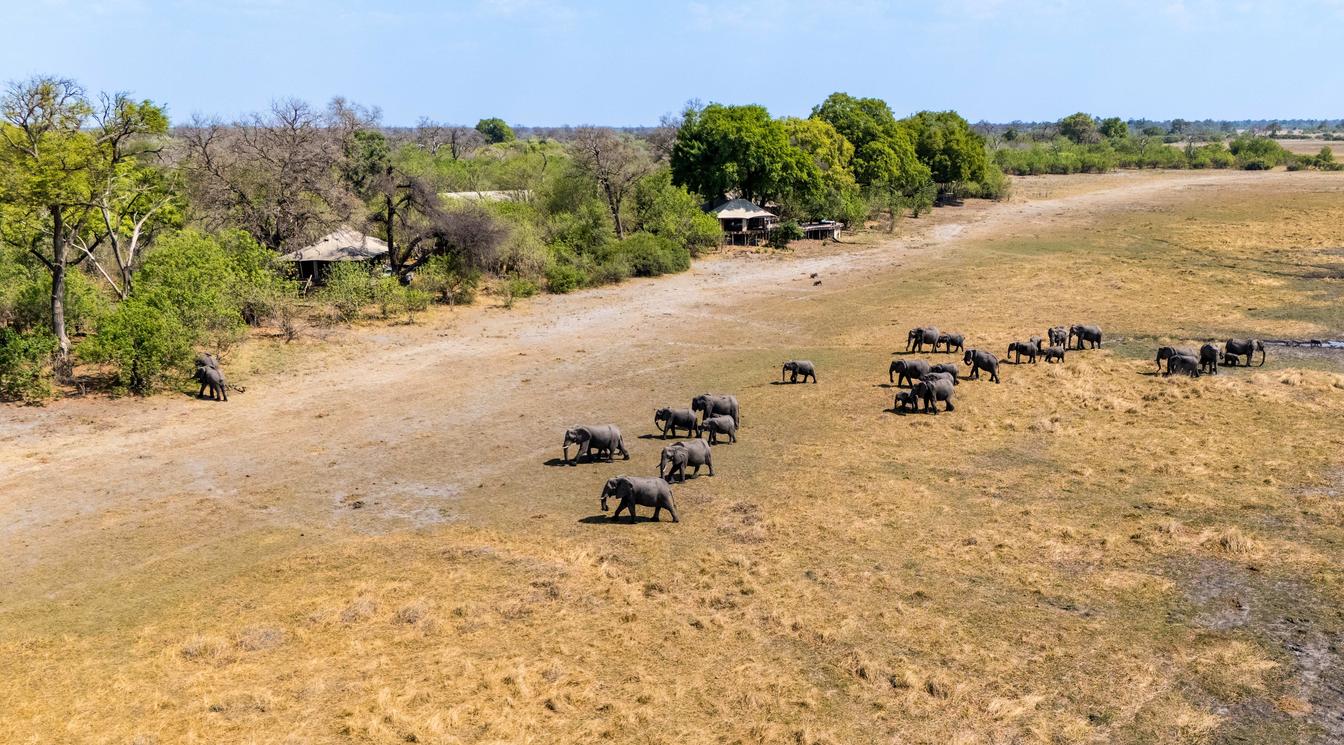
Botswana - Fly-in safari
10-Day Delta & Desert Odyssey
The journey
Updated on 18 September 2026
This is Botswana's top shelf. Mombo has been called the best game-viewing camp in Africa for thirty years, and the claim survives scrutiny: it sits on the northern tip of Chief's Island in the Moremi Game Reserve, on floodplains that carry extraordinary densities of lion, leopard and plains game. Zarafa, a four-suite Relais and Chateaux camp on the Zibadianja Lagoon in the private Selinda Reserve, swaps the crowds for 130,000 acres shared with one other camp. Jack's Camp is the strangest and most loved of the three, a Persian-carpeted explorer's camp on the edge of the Makgadikgadi salt pans. The order matters. You open on the delta's abundance, move to the Linyanti's raw predator country, and end in the desert, where the game viewing gives way to meerkats, San tracking and the silence of the pans. Each leg is a short light-aircraft hop. Dry season, May to October, is prime for Mombo and Zarafa. The pans turn green and fill with zebra between December and March, so every season has an argument.Your camps, day by day
Stay 1
Maun and Into Moremi
Stay 2
The Mombo Floodplains
Stay 3
Predators at Close Range
Stay 4
North to the Linyanti
Stay 5
The Selinda Spillway
Stay 6
Dogs, Boats and Hides
Stay 7
South to the Salt Pans
Stay 8
Meerkats and the San
Stay 9
Onto the Pans
Stay 10
Desert to Johannesburg
Safari highlights
- Three nights at Mombo, Botswana's most decorated camp
- Three nights at Zarafa on the Zibadianja Lagoon
- 130,000 private acres in the Selinda Reserve
- Three nights at Jack's Camp on the Makgadikgadi pans
- Habituated meerkats and San tracking in the desert
- All legs flown by light aircraft
What is included
Included
- 9 nights accommodation, per person sharing
- Return regional flights Johannesburg-Maun in economy class
- Light-aircraft sectors Maun-Mombo, Mombo-Zarafa, Zarafa-Jack's Camp and Jack's Camp-Maun, with airstrip taxes
- All meals, house wines, local spirits, beers and soft drinks
- Twice-daily game drives, mokoro and boating where water levels allow, and desert activities
- Moremi Game Reserve and private concession fees, government levies and VAT
- Botswana Tourism Development Levy of USD 30 per person
- Laundry and emergency medical evacuation cover
Not included
- International flights to and from Africa
- Visas and entry permits
- Comprehensive travel and medical insurance
- Premium spirits, champagne and imported wines
- Gratuities for guides, trackers and camp staff
- Items of a personal nature, curios and telephone calls
Frequently asked questions
How much does a 10-day luxury Botswana safari cost?
This routing starts at USD 41,080 per person sharing and reaches about USD 52,480 in peak season. It is priced off three of the most expensive camps in Africa: Mombo, Zarafa and Jack's Camp. The rate covers all meals and house drinks, private concession fees, four light-aircraft sectors and the return Johannesburg-Maun flights. International flights to Africa are excluded and quoted separately.
Is Mombo really worth the price?
Mombo's floodplains carry game densities that most camps cannot match: resident leopard along the treelines, lion prides that hold territories within a short drive of camp, and big herds of lechwe, impala and buffalo that keep them there. The camp itself, rebuilt in 2018, runs nine suites on raised walkways. If one camp in Africa justifies its rate on game viewing alone, it is this one.
What do you actually do at Jack's Camp?
The desert flips the safari format. You sit inside a habituated meerkat colony at sunrise, walk with Zu/'hoasi San trackers who read the ground like text, ride quad bikes onto the pans in the dry season, and visit Chapman's Baobab. Between December and March the pans green over and tens of thousands of zebra arrive, Botswana's own migration.
When is the best time for this safari?
May to October gives the classic dry-season game viewing at Mombo and Zarafa, with the delta flood peaking June to August. December to March is the desert's season, when the zebra migration masses on the green pans. April, May and November are the compromise months that catch both ends. There is no wrong answer, only different films.
Are international flights included?
No. International flights to and from Africa are excluded and booked separately, normally via Johannesburg. The price includes the return Johannesburg-Maun regional flights, about 1 hour 40 minutes each way, and every light-aircraft sector between camps. Light aircraft enforce a 20 kg luggage limit per person in soft-sided bags.
Is northern Botswana a malaria area?
Yes. The delta and the Linyanti are malaria areas, highest risk from November to April. The Makgadikgadi is lower risk but not risk-free. Prophylaxis is recommended for the whole routing; talk to a travel clinic about six weeks out. Camps provide repellent and screened tents. A yellow fever certificate is required only if arriving from a country with transmission risk.