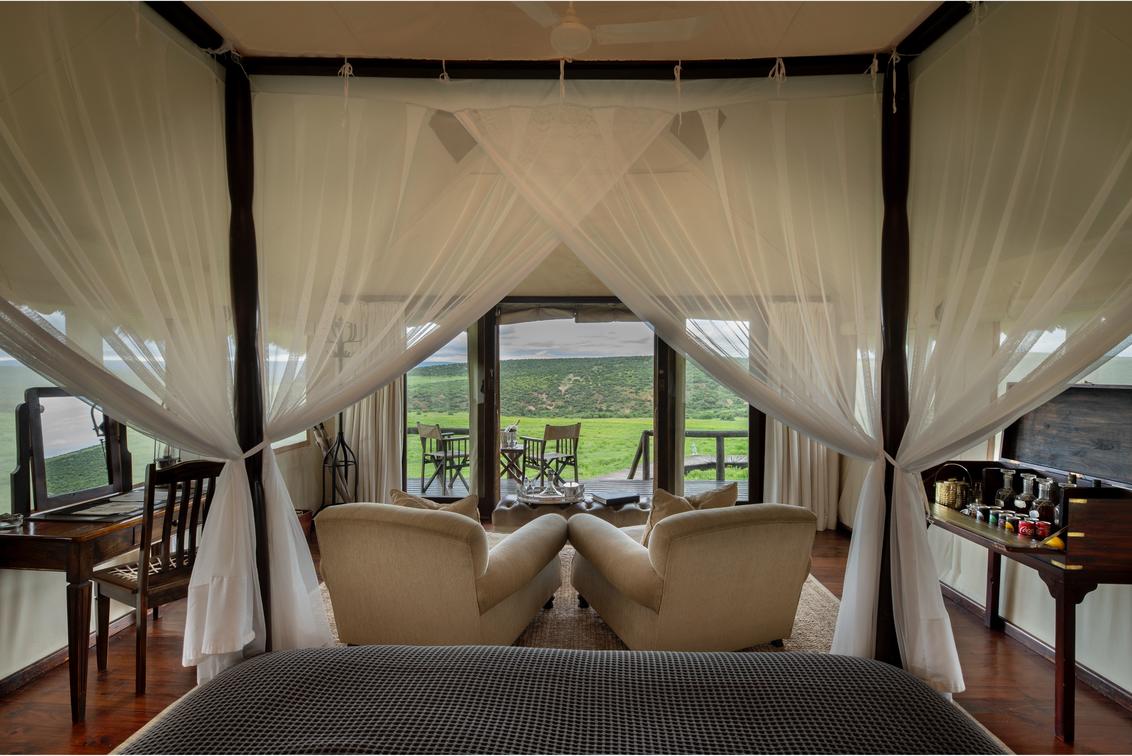
South Africa - Fly-in safari
7-Day Addo & Plettenberg Bay Escape
The journey
Updated on 18 September 2026
This is the Eastern Cape's answer to the classic bush-and-beach formula, and it needs no malaria tablets, no light aircraft and no long-haul repositioning: one hire car or one driver covers the lot. It begins at Gorah Elephant Camp, the only lodge inside Addo Elephant National Park itself, where eleven colonial-era tents surround a gracious 1856 manor house and the waterhole in front of the deck runs like a station platform for the park's six hundred elephants. Drives here are about density: elephant families at arm's length, buffalo, lion, and the endearing flightless dung beetle with right of way on every road. Then the road runs west along the N2 into the Garden Route, two and a half hours, to The Plettenberg, perched on a rocky headland with whales breaching in the bay below in season. Three nights covers the coast's greatest hits: the Robberg Peninsula's seal colony and hiking trails, Birds of Eden and the Monkeyland sanctuaries, beach mornings and Lookout Deck oysters. June to November adds southern right whales; summer adds beach weather. Either way it is South Africa at its most effortless.Your camps, day by day
Stay 1
Gqeberha to Gorah
Stay 2
Six Hundred Elephants
Stay 3
The Wider Park
Stay 4
The N2 to the Bay
Stay 5
Robberg and the Seals
Stay 6
Forest, Sanctuaries, Sea
Stay 7
Bay to Gqeberha
Safari highlights
- Three nights at Gorah, the only camp inside Addo
- Six hundred elephants and a busy camp waterhole
- Completely malaria-free safari
- Three nights at The Plettenberg above the bay
- Robberg Peninsula walks and whale season
- One easy self-drive or chauffeured route
What is included
Included
- 6 nights accommodation, per person sharing
- Road transfers Gqeberha Airport-Gorah, Gorah-Plettenberg and Plettenberg-Gqeberha
- All meals and local drinks at Gorah Elephant Camp
- Breakfast daily at The Plettenberg
- Twice-daily game drives at Gorah
- Addo Elephant National Park conservation fees
- Government taxes and VAT
- Emergency medical evacuation cover
Not included
- International flights to and from Africa
- Domestic flights to Gqeberha, quoted separately
- Visas and entry permits
- Comprehensive travel and medical insurance
- Lunches and dinners in Plettenberg Bay
- Gratuities for guides, drivers and hotel staff
- Items of a personal nature and telephone calls
Frequently asked questions
How much does a 7-day Addo and Plettenberg Bay trip cost?
From USD 5,780 per person sharing, rising to about USD 6,280 in peak season, one of the most accessible price points in luxury South African travel. It covers three fully catered nights at Gorah Elephant Camp with game drives and park fees, three bed-and-breakfast nights at The Plettenberg, and all road transfers. International and domestic flights are excluded and quoted separately.
Is this really malaria-free?
Yes, entirely. The Eastern Cape and the Garden Route lie well outside South Africa's malaria zone, so no prophylaxis is needed at any time of year. That, plus short road transfers instead of light aircraft, makes this route the standard recommendation for families with young children, pregnant travellers and anyone who wants the Big Five without the tablets.
What is special about Gorah Elephant Camp?
Position. Gorah holds the only private concession inside Addo Elephant National Park, so its eleven tents and 1856 manor house sit in the middle of the park's traffic rather than at its edge. The waterhole in front of the deck draws elephant through the day, sometimes fifty at once, and dinner is served by candlelight as they rumble past in the dark.
When can you see whales in Plettenberg Bay?
Southern right whales calve in the bay from roughly June to November, with humpbacks passing on migration in early and late season; The Plettenberg's cliff-top position turns breakfast into a whale watch. Bottlenose and common dolphins are resident year-round, and boat-based whale watching and the Robberg seal colony run in every month.
How do you get there and around?
Fly into Gqeberha, formerly Port Elizabeth, which connects to Johannesburg and Cape Town in about 1 hour 40 minutes. Gorah is then a 45 minute road transfer, and the drive from Addo to Plettenberg Bay along the N2 takes about 2 hours 30 minutes through the Tsitsikamma forests. All road legs are included; many guests convert them to self-drive.
Are international flights included?
No. International flights to and from Africa are excluded, as are the short domestic legs to Gqeberha, which we quote at the time of booking to match your routing. Everything on the ground, transfers, Gorah's full board and game drives, park fees and The Plettenberg's breakfasts, is included in the published price.