Tanzania - Fly-in safari
8-Day Calving Season Safari
The journey
Updated on 18 September 2026
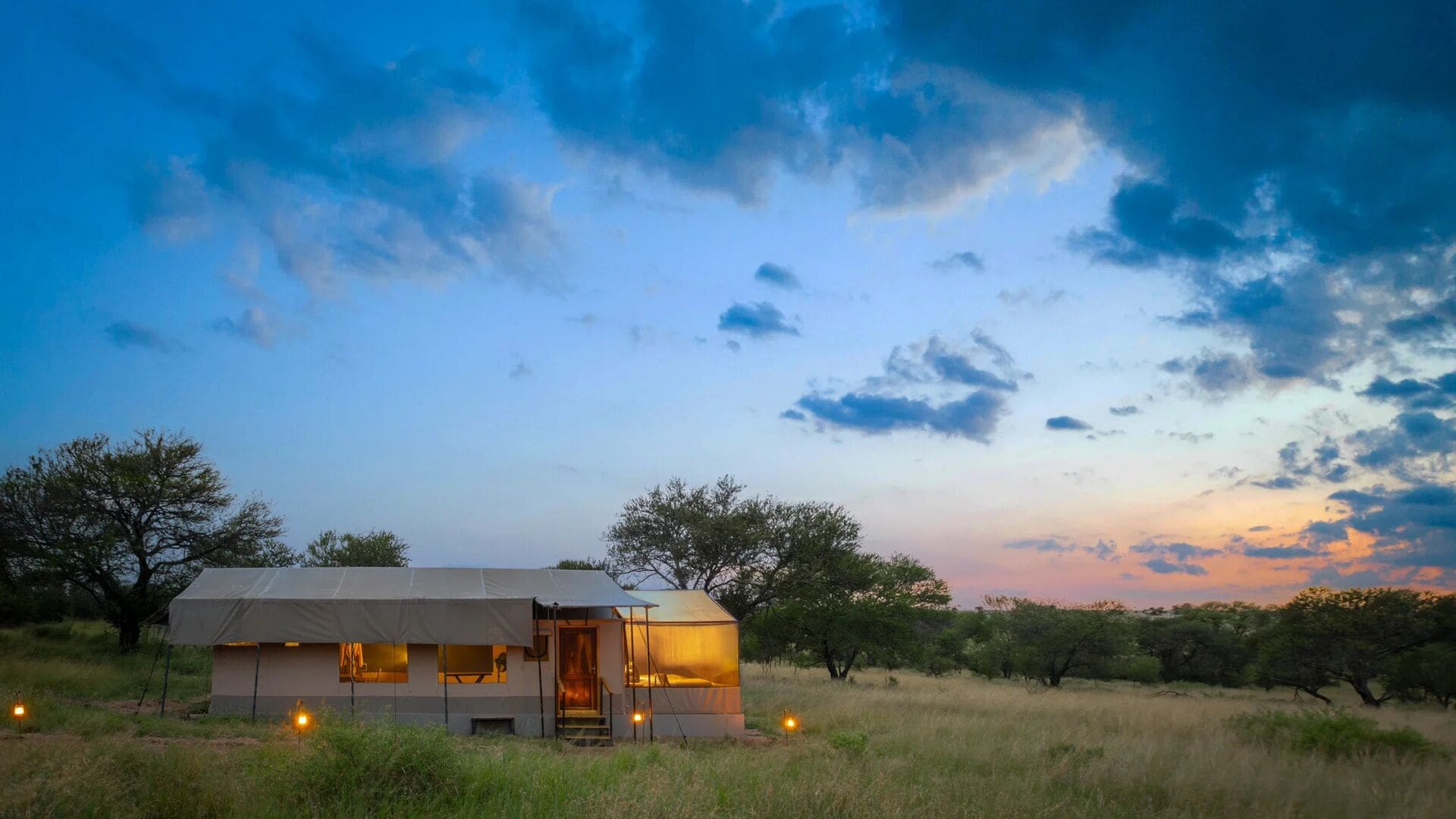
The southern Serengeti behaves differently between late January and mid-March. Roughly half a million wildebeest calves are born on the short-grass plains around Ndutu over about six weeks, some 8,000 a day at the peak, and every predator in the ecosystem moves in behind them. The grass here grows on volcanic ash blown off Ngorongoro and Kerimasi, which makes it unusually high in calcium and phosphorus. That soil chemistry, not scenery, is why the herds come this far south to give birth. This programme runs on those dates and no others, roughly December to March. Four nights are spent at Olakira Migration Camp, which is dismantled, loaded onto trucks and rebuilt twice a year so that it sits where the animals are rather than where a lease happens to be. In a dry year the herds shift fifty kilometres east or west and the camp shifts with them. A fixed lodge cannot do that. The last two nights climb to The Highlands on the forest edge of Olmoti, an hour from the descent road into the Ngorongoro Crater, which is green, full and at its best in exactly these months.Your camps, day by day
Stay 1
Arrival in Arusha
Stay 2
Down to the Calving Grounds
Stay 3
Births on the Short Grass
Stay 4
Marsh, Lake and Cheetah
Stay 5
Following the Herds West
Stay 6
Across the Conservation Area
Stay 7
Down into the Crater
Stay 8
Olmoti and Home
Safari highlights
- Four nights at Ndutu when about 8,000 calves are born a day
- A mobile camp that moves with the herds, not a fixed lodge
- Olakira's roll-back star beds on the short-grass plains
- Dawn descent into the Ngorongoro Crater from Olmoti
- Runs December to March only, and peaks in February
- Every Ngorongoro entry, concession and crater fee costed in
What is included
Included
- 7 nights accommodation, per person sharing
- Light aircraft flights Arusha to Ndutu airstrip, and Lake Manyara airstrip to Kilimanjaro International
- Road transfers: Kilimanjaro International to Legendary Lodge, the private game-viewing transfer from Ndutu across the conservation area to The Highlands, and The Highlands down to Lake Manyara airstrip
- Full board with house drinks, scheduled game drives in open vehicles and laundry at Olakira Migration Camp and The Highlands; dinner, bed and breakfast plus arrival lunch at Legendary Lodge
- Ngorongoro Conservation Area entry at USD 70.80 per adult per 24 hours, for all six nights spent inside the conservation area
- Ngorongoro special campsite and concession fees of USD 59 per person per night at Ndutu and in the highlands
- Ngorongoro crater service fee of USD 295 per vehicle plus 18 per cent VAT for one descent, and one Serengeti National Park day entry for drives that cross the boundary west of Ndutu
- Guided Olmoti Crater walk with a Maasai ranger from The Highlands
- Tanzania tourism development levy and AMREF Flying Doctors evacuation cover
Not included
- International flights to and from Africa
- Tanzanian visa, currently USD 50 on arrival for most nationalities and USD 100 for United States passport holders
- Travel and medical insurance, including cancellation cover
- Premium spirits, champagne and imported wines
- Hot air balloon safari over the Ndutu plains, from about USD 599 per person
- Gratuities for guides, pilots and camp staff
- Items of a personal nature
Frequently asked questions
When exactly is the calving season in the Serengeti?
The herds move onto the southern short-grass plains around Ndutu from late December, once the short rains have brought the grass up. Calving builds through January, peaks in the first three weeks of February at roughly 8,000 births a day, and tails off across the first half of March. Late January to mid-March is the reliable window. December is arrival, not calving.
How likely am I to see a wildebeest birth or a kill at Ndutu?
Over four nights in early or mid February, seeing a birth is close to routine: most calves are dropped between mid-morning and early afternoon, in the open, often several at once within view. A kill is a different matter. Our guides reckon roughly half of four-night guests watch a hunt through to a kill. Nobody can promise it, and any operator who does is guessing.
How much does an 8-day calving season safari in Tanzania cost?
From USD 12,180 per person sharing for a March departure, rising to about USD 14,880 for late January and February, which is peak. That covers seven nights at Legendary Lodge, Olakira Migration Camp and The Highlands, both light aircraft sectors, all road transfers, full board with house drinks in the bush, every game drive, and all Ngorongoro entry, concession and crater descent fees.
Are international flights included in the price?
No. International flights to and from Africa are excluded and you book them into Kilimanjaro International Airport yourself, usually via Amsterdam, Doha, Istanbul, Addis Ababa or Nairobi. Everything that flies inside the itinerary is included: the light aircraft from Arusha to Ndutu airstrip, about 90 minutes with one stop, and Lake Manyara back to Kilimanjaro, about 40 minutes.
Why stay in a mobile camp rather than a lodge for the calving season?
Because the calving grounds move. In a wet year the herds sit tight around Ndutu and Lake Masek; in a dry one they drift fifty kilometres east towards Salei or west into Kusini and Maswa. Olakira is struck and rebuilt twice a year to follow them, so you drive minutes to the animals instead of two hours. Fixed lodges in the south cannot move.
Is January to March a good time to visit Tanzania?
For the southern Serengeti, yes, and it is high season there: 20 December to 28 February carries peak camp rates. Expect short, heavy afternoon storms rather than all-day rain, green grass and strong light for photography. The long rains arrive in April, when most of these camps close. Northern Serengeti and Tarangire are at their weakest in these months, which is why this route stays south.
How much are Ngorongoro Conservation Area fees in 2026?
Entry is USD 70.80 per non-resident adult per 24 hours, plus a concession or special campsite fee of about USD 59 per person per night for camps inside the area. The crater service fee is USD 295 per vehicle plus 18 per cent VAT for a single descent of up to six hours. Ndutu sits inside the conservation area, not the national park, so these are the fees that apply for six of your seven nights.