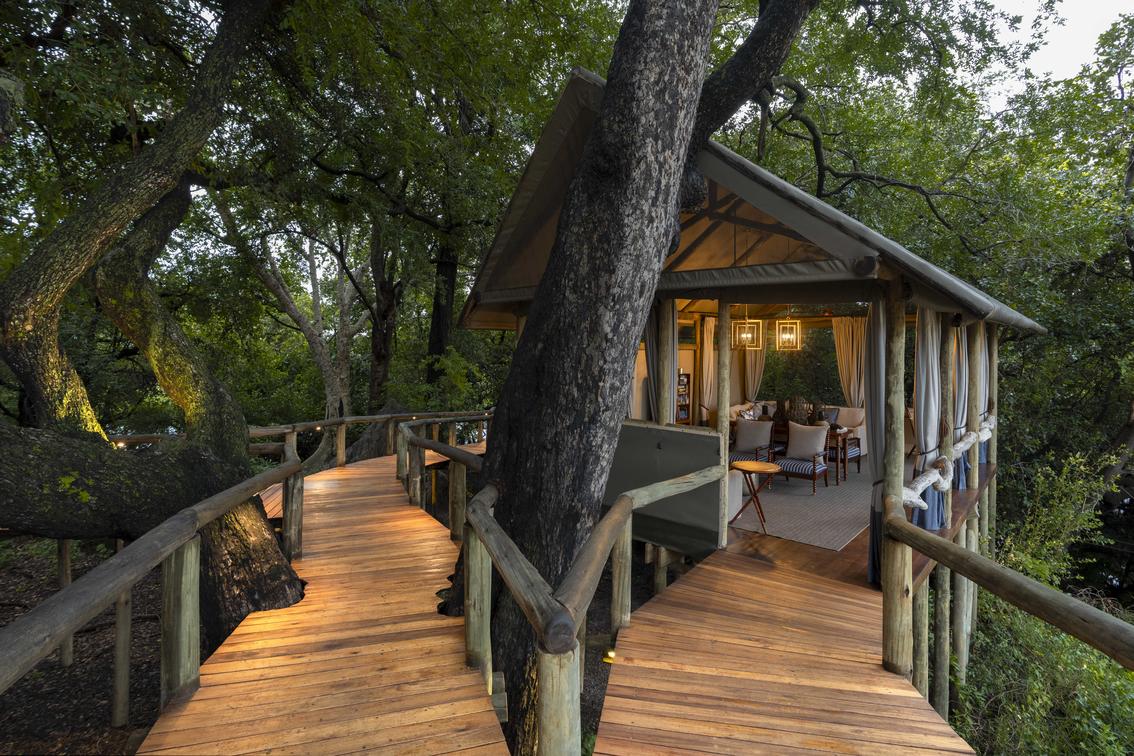
Botswana - Fly-in safari
8-Day Okavango Photographic Safari
The journey
Updated on 18 September 2026
This is a programme built backwards from what photographers actually need: fewer camps, longer stays, and a vehicle nobody else is sitting in. You spend four nights at Shinde, on a private concession in the northern Okavango, where every seat carries its own camera mount and six guests is the maximum. Then three nights at Chitabe in the south, a 22,000-hectare private concession bordered on three sides by Moremi Game Reserve, rebuilt in 2025 and long used by wildlife photographers for its wild dog. The order is deliberate. Shinde gives you water and land in the same day, and a boat drops you to eye level with red lechwe and drinking elephant in a way no vehicle can. Chitabe is drier ground, dust and hard backlight, and predators that hunt in the open. May to October is the working window. June to August holds the flood and the cleanest morning light, while September and October are hot and dusty and produce the strongest predator work. The private photographic vehicle and guide are charged per vehicle per night and are built into the price, because without them this is just another safari.Your camps, day by day
Stay 1
North to Shinde Lagoon
Stay 2
Eye Level with the Water
Stay 3
A Full Day, No Deadline
Stay 4
Mokoro and Spotlight
Stay 5
South to Chitabe
Stay 6
Wild Dog and Dust
Stay 7
Last Light on the Floodplain
Stay 8
Chitabe to Maun
Safari highlights
- Private photographic vehicle and guide at both camps, included
- Shinde: an individual camera mount on every seat, six guests maximum
- Boats and mokoro for water-level angles on lechwe and elephant
- Chitabe's 22,000-hectare private concession, and its wild dog
- Out before sunrise, back after dark, on your own schedule
- Two camps in eight days, so no morning is lost to flying
What is included
Included
- 7 nights accommodation, per person sharing
- Private photographic vehicle and private guide throughout, at both camps, charged per vehicle per night and built into this price
- Light aircraft flights Maun-Shinde, Shinde-Chitabe and Chitabe-Maun
- All road and boat transfers between airstrips and camps
- All meals and local drinks at both camps, including house wines, beers and spirits
- Twice-daily activities: game drives, night drives under a filtered spotlight, guided walks, motorboat and mokoro where water permits
- All park, concession and conservation fees, plus the Botswana tourism development levy
- Daily laundry and in-room charging points at both camps
Not included
- International flights to and from Africa
- Visas and any entry fees payable on arrival
- Travel and medical insurance, including emergency evacuation cover
- Camera and lens hire, memory cards, and any extra freight seat booked for equipment
- Premium imported spirits and champagne
- Helicopter and scenic flights
- Gratuities and items of a personal nature
Frequently asked questions
How much does an 8-day Okavango photographic safari cost?
This programme starts at USD 20,580 per person sharing in shoulder season and runs to about USD 26,380 in peak season. That covers seven nights at Shinde and Chitabe, all three light aircraft sectors, all meals and local drinks, park and concession fees, the Botswana tourism levy, and the private photographic vehicle and guide at both camps, which alone is roughly USD 3,650 for the week. International flights are not included.
Is a private vehicle worth it on safari?
For photography, yes. Shinde charges USD 500 per vehicle per night and Chitabe about USD 550, so a week costs around USD 3,650, or USD 1,825 each for two sharing and half that split four ways. It buys you the right to leave forty minutes before the other vehicles, sit at one sighting for three hours, and position for the light rather than the view. If you shoot casually on a phone, skip it and save the money.
What lens do I need for an Okavango safari?
One 100-400mm or 200-600mm zoom on a full-frame body does about 80 per cent of the work. Add a 70-200mm for animals in landscape and a 24-70mm for camp, skies and mokoro. A 600mm prime is usually more than the Delta needs, because in a private concession your guide can put you within 15 metres. Bring two bodies so you never change a lens in dust.
Are there photographic hides in the Okavango Delta?
Very few, because the water table sits close to the surface and floods most of the year. Wilderness Mombo has a ground-level hide on Chief's Island, and Ker and Downey's Dinaka in the Kalahari has an underground bunker hide at a waterhole, which we can add as a two-night extension. In the Delta itself the boat is the hide: it puts your lens about 30 centimetres above the water.
How do I charge camera batteries in an Okavango safari camp?
Both Shinde and Chitabe run on solar with battery banks and have charging points in the rooms, so you can charge overnight without going to the main area. Chitabe's rooms were rebuilt in 2025 with sockets at the desk. Bring a multi-plug adapter for Botswana's Type G and Type M sockets, four batteries per body, and charge every night rather than waiting until a battery dies.
How do I protect my camera from dust on a Botswana safari?
September and October are the dusty months. Change lenses inside the vehicle with the engine off and your back to the wind, or better, carry two bodies and never change at all. A rocket blower and a microfibre cloth live in your bag. Light aircraft allow 20 kg per person in a soft bag including camera gear, so most photographers buy an extra freight seat for about USD 300 per sector.
Are international flights included in the price?
No. International flights to and from Africa are excluded, so you book your own flights into Maun, usually through Johannesburg with Airlink or Air Botswana. Everything inside the itinerary is included: the light aircraft sectors Maun to Shinde, Shinde to Chitabe and Chitabe to Maun, and all road and boat transfers between the airstrips and the camps.