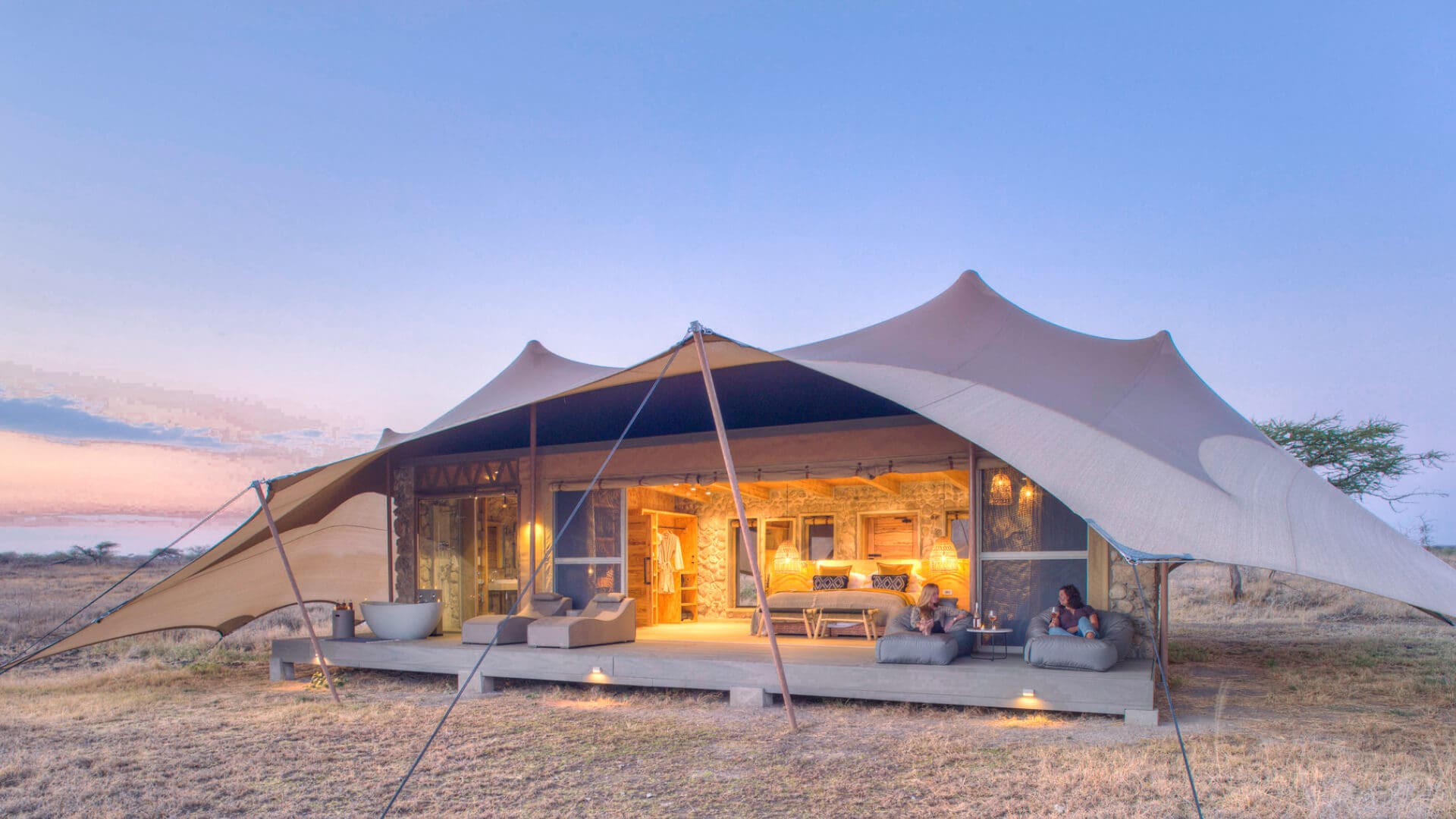
Tanzania - Fly-in safari
8-Day Serengeti & Ngorongoro Fly-In Safari
The journey
Updated on 18 September 2026
Tanzania's northern circuit is usually driven. The road from Arusha to the Serengeti runs about 320 kilometres and takes most of a day in each direction, with a further half day lost crossing the park to reach the far north. This programme flies it. Four light aircraft sectors replace roughly eighteen hours behind a windscreen, and that time goes back into game viewing. That is the main reason it costs more than the seven-day road version, and the main reason people choose it. You spend three nights at Namiri Plains in the eastern Serengeti, an area closed to visitors for two decades while cheetah numbers recovered, then two nights at Sayari on the Mara River in the far north. From June to October the herds are in the north and the river crossings are the draw. From December to March we swap the second leg south to the Ndutu calving grounds, which the same aircraft reach just as easily. The last night sits on the Ngorongoro rim at Lemala, ten minutes from a descent road, so you are on the crater floor at first light rather than queueing behind the day visitors from Arusha.Your camps, day by day
Stay 1
Arrival in Arusha
Stay 2
Flight to the Eastern Plains
Stay 3
Cheetah on the Kopjes
Stay 4
Deep into the Serengeti
Stay 5
North to the Mara River
Stay 6
Waiting on the Bank
Stay 7
Up to the Crater Rim
Stay 8
Down into the Crater
Safari highlights
- Four light aircraft sectors instead of 18 hours on the road
- Three nights at Namiri Plains, the Serengeti's cheetah country
- Mara River crossings from Sayari Camp, June to October
- Second Serengeti leg swaps to the Ndutu calving grounds in season
- Dawn descent into the Ngorongoro Crater, ahead of the day visitors
- Every park, concession and crater fee costed and included
What is included
Included
- 7 nights accommodation, per person sharing
- Light aircraft flights Arusha-Seronera, Seronera-Kogatende, Kogatende-Lake Manyara and Lake Manyara-Kilimanjaro
- Road transfers Kilimanjaro Airport to Arusha, and Lake Manyara airstrip to the Ngorongoro Crater rim
- All meals and house drinks at Namiri Plains, Sayari Camp and Lemala Ngorongoro; dinner, bed and breakfast at Legendary Lodge
- Twice-daily game drives and guided walks at Namiri Plains and Sayari Camp
- Private 4x4 and guide in the Ngorongoro Conservation Area, including a full morning on the crater floor
- Serengeti National Park entry at USD 83 per person per 24 hours and the Serengeti concession fee at USD 71 per person per night, for all five nights in the park
- Ngorongoro Conservation Area entry at USD 83 per person, the Ngorongoro concession fee of USD 59, and the crater service fee of USD 295 per vehicle per descent
- Laundry at all three safari camps
Not included
- International flights to and from Africa
- Tanzanian visa, currently USD 50 on arrival for most nationalities, and any locally payable departure taxes
- Travel and medical insurance, including emergency evacuation cover
- Premium spirits, champagne and imported wines
- Hot air balloon safari over the Serengeti, from about USD 599 per person
- Gratuities for guides, pilots and camp staff
- Items of a personal nature
Frequently asked questions
How much does an 8-day Serengeti and Ngorongoro fly-in safari cost?
This programme starts at USD 14,980 per person sharing in shoulder season and reaches about USD 20,080 at peak. That covers seven nights at Legendary Lodge, Namiri Plains, Sayari Camp and Lemala Ngorongoro, all four light aircraft sectors, all road transfers, all meals and house drinks in the bush, every game activity, and all Serengeti and Ngorongoro fees including the crater service fee.
Is it better to fly or drive the Serengeti and Ngorongoro circuit?
Flying costs roughly USD 3,000 to 4,000 more per person and buys back about eighteen hours of driving. Arusha to Seronera is 70 minutes in the air against seven to eight hours by road, and Seronera to Kogatende in the far north is 45 minutes against five hours. Driving is the better choice only if you want to see Tarangire and Lake Manyara on the way.
Are international flights included in the price?
No. International flights to and from Africa are excluded and you book them yourself into Kilimanjaro International Airport, usually via Amsterdam, Doha, Istanbul, Addis Ababa or Nairobi. Every flight inside the itinerary is included: the light aircraft sectors from Arusha to Seronera, Seronera to Kogatende, Kogatende to Lake Manyara and Lake Manyara back to Kilimanjaro.
How much are Serengeti and Ngorongoro park fees in 2026?
Serengeti entry is USD 83 per non-resident adult per 24 hours, plus a concession fee of about USD 71 per person per night for camps inside the park. Ngorongoro Conservation Area entry is USD 83 per person per 24 hours, the concession fee is USD 59, and the crater service fee is USD 295 per vehicle per descent. All of these are included here.
When is the best time to see the Mara River crossings in the Serengeti?
July to October, with August and September the most reliable months at Kogatende, where Sayari Camp sits. Crossings are unpredictable and can involve hours of waiting on the bank. If you travel between December and March we send you to the Ndutu calving grounds in the south instead, where roughly 8,000 wildebeest are born each day in February.
How many nights do I need in the Serengeti?
Five is the sensible minimum if you want two contrasting areas, which is what this programme does: three nights in the eastern Serengeti at Namiri Plains and two in the north at Sayari. Anything less and you spend a disproportionate share of your time in transit. The Serengeti covers 14,750 square kilometres and the two areas look nothing alike.
Do I need vaccinations or malaria tablets for Tanzania?
A yellow fever certificate is required only if you are arriving from or transiting more than twelve hours through a country with risk of transmission, which includes Kenya, Uganda and Ethiopia. Tanzania is a malaria area and prophylaxis is advised for the Serengeti. Risk on the Ngorongoro rim is low because the camps sit at about 2,300 metres. Ask your doctor eight weeks ahead.